
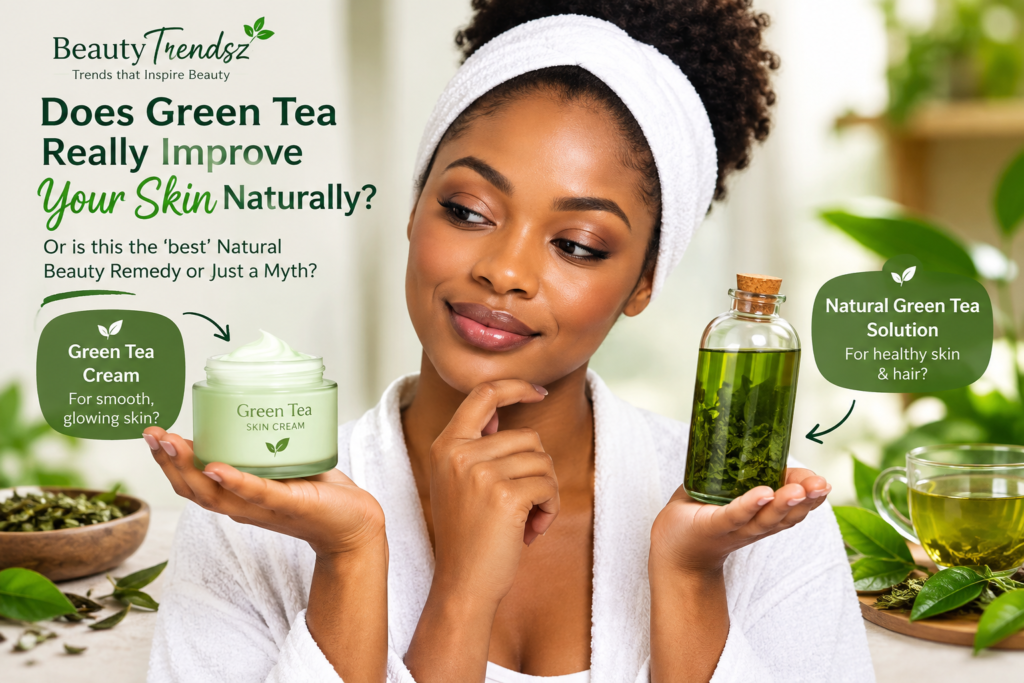
Does Green Tea Really Improve Your Skin NATURALLY?
Or is this the ‘best’ Natural Beauty Remedy or Just a Myth?
💡 Affiliate Disclosure: This post may contain affiliate links. As an Amazon Associate, BeautyTrendsz earns from qualifying purchases at no additional cost to you.
What fascinates me is that one of the most common kitchen ingredients suddenly becomes a natural beauty product. And this is green tea, that which many people drink it for its unique yet naturally refreshing taste.
At the same time, green tea’s natural ingredients and extracts are commonly used in skin serums, cleansers, creams and face masks with the sole aim of giving you that smooth glossy look.
But the bubbling question running around your mind and mine is whether green tea can really help improve the health of your skin, and in this case, is applying green tea directly on your skin really beneficial than what it is naturally meant for or is this yet another myth that has turned into a natural beauty trend?
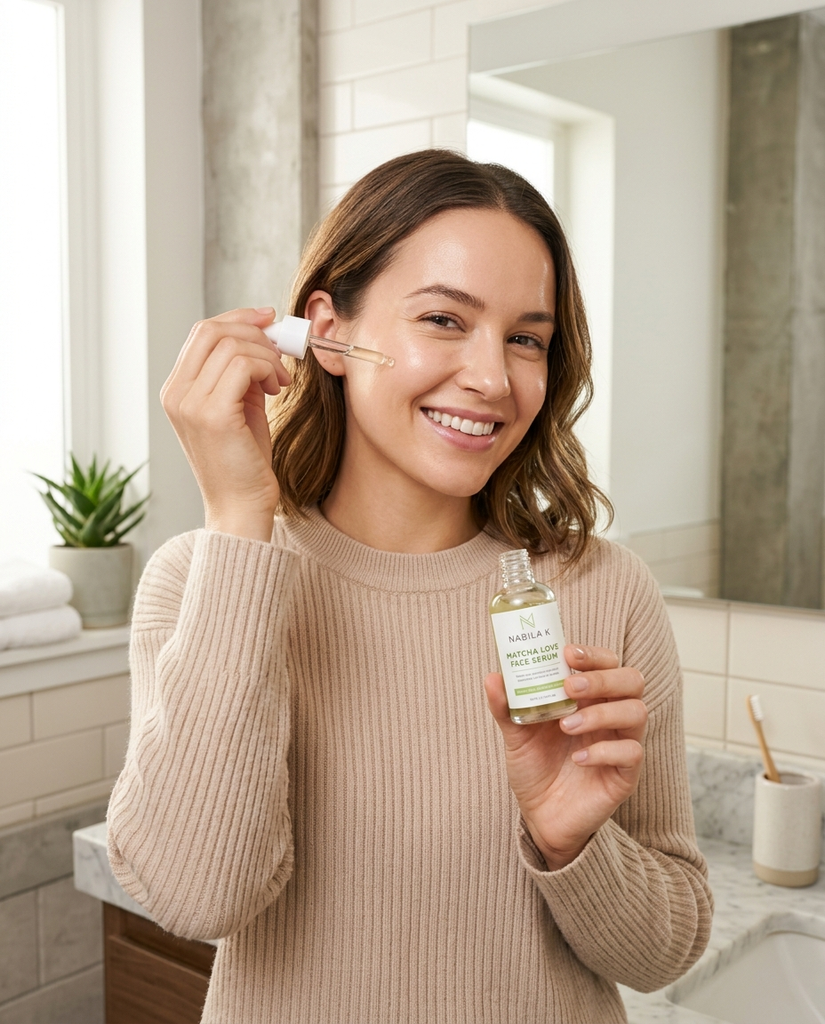
Surprisingly, green tea originates from natural leaves of Camellia sinensis plant, pretty much the plant that produces your ordinary black tea and other tea varieties. The main difference between green tea and black tea is that the green tea is specially processed to ensure that naturally occurring polyphenols, are well preserved as well as catechins for example, epigallocatechin gallate (EGCG).Most of all, one of the things that stands out the most in this natural fascination is the extent that green tea carries a high concentration of essential skin care plant compounds and extracts, such as anti-inflammatory and antioxidant properties.
Research by PMC shows that green tea has the right ingredients and properties that can help with skin aging and acne, however, there is no sufficient evidence and facts to prove that green tea is a miraculous natural skin care remedy.
In this article, Beauty Trends team looks at the potential benefits of green tea on your skin, what research has been conducted surrounding this natural skin care remedy, the possible risks of using green tea on acne prone skin, demystifying all beauty, skin acne and skin aging claims around green tea and how to use or apply green tea on your skin.
Most of all, I will not expect green tea to transform my skin care looks or health overnight. It is important to note that natural skin care remedies can be useful, but you must always have realistic expectations.
What Is Green Tea?
Green tea comes from leaves of Camellia sinensis. The major difference of green tea from black tea and other tea varieties is that green tea is taken through a different way of processing that exposes the green tea leaves to minimal oxidation process. As a result, which resultantly preserves all the naturally occurring ingredients and extracts of green tea commonly referred to polyphenols.
One of the said preserved natural ingredients is catechins, with EGCG remaining the most coveted ingredient that does the magic sort to speak.
Some of these crucial natural ingredients and extracts have been taken through a raft of studies and research especially determining and ascertaining their rich anti-inflammatory and antioxidating proponents that come out as the right natural remedies for skin acne or generally a healthy skin.
Historically, green tea has been used for many years and in many cultures and traditions, especially in Asian countries.
In the recent years, green tea has found a fresh space in the beauty niche, often crafting its name as one of the leading natural beauty or skin care product.
Green tea is now used as a cosmetic product, often for skin care and most of all body care.
In beauty and skin care perspectives, green tea is surprisingly creating a big beauty trend, originating from its natural compound, the polyphenol content, and the natural ability of its natural extracts to deliver green tea’s ingredients to the skin.
With all said and done, it is very important to make a clear-cut distinction between a hot cup of green tea and a set of skin care creams and lotions. The two, will never be the same or offer you the same results, and thus caution must be applied when looking out for specific skin health results.
Experts say that the concentrations of green tea and skin care products are different and in fact the modes of applications differ as well as absorption of ingredients to your skin, thus you should not expect that one product will replace or outdo the other, but maybe complement each other.
What are the potential Benefits of homemade Green Tea for Skin
May Help Soothe the Skin
One of the main reasons why green tea is curving trends in the beauty and skin care industry far and wide, is its natural anti-inflammatory proponents.
Laboratory and clinical research has studied green tea polyphenols for inflammatory skin or facial skin health conditions. However, the findings don’t directly imply that applying natural and homemade green tea to irritating skin will bring similar results.
In this regard, I perceive green tea as a potentially soothing cosmetic/beauty ingredient rather than a remedy for a skin health condition.
May Support Skin’s Overall Appearance/look
The antioxidant activity of green tea polyphenols is yet another natural reason green tea finds its place in beauty and cosmetic products and routines. Antioxidants can help neutralize reactive molecules involved in oxidative stress.
Even as green tea sounds like the best natural product for getting rid of skin acne or other related skin conditions, I would be careful about trying to use green tea with the aim of getting rid of skin wrinkles or reversing aging.
According to a randomized study by PubMed that involved 29 women, established that a specially prepared green tea extracts was linked to some improvements in the following criteria: skin elasticity and skin dullness following a number of weeks. However, the research team relied on a formulated green tea extract provided by using a distinctive encapsulation research system—but not mere a cold or cool green tea from a kitchen mug. (PubMed)
This indeed why I prefer to state that green tea may support healthy-looking skin instead of making false claims that homemade green tea reverses aging or gets rid of skin acne or skin blemishes.
May Help Improve the Appearance of Acne-Prone Skin
And to be honest with you, this is exactly where the research becomes specifically interesting.
A systematic review and meta-analysis of five randomized clinical studies that brought together 247 participants as cited from PubMed established and concluded that green tea extracts and ingredients were linked to the lowering of inflammatory skin acne abrasions. The researchers found stronger effects with topical application than with oral intake, while also noting that further high-quality studies are needed. (PubMed)
The same studies and reviews also came to the conclusion that topical green tea polyphenols may lower the levels of sebum production and benefit acne prone skin, but highlighted that larger and higher-quality research studies are still required. (PubMed)
Therefore, if I would consider green tea for acne-prone skin, I would treat it as a potential supporting natural extracts or ingredient—but not a complete replacement for proven skin acne treatments.
Potential Benefits of Green Tea for Hair
You must have noticed that green tea is sometimes advertised online as another natural remedy for hair loss and scalp health problems. This is the exact point where you must be extra careful.
How green tea May Benefit the Scalp
Green tea is known to contain polyphenols that researchers have studied for years for their antioxidant and anti-inflammatory properties. These characteristics make green tea an interesting ingredient for cosmetic scalp products.
Moreover, it is clear that facts and evidence to prove green tea’s efficiency in treating scalp conditions is limited.
Equally, there is no sufficient evidence to prove that drinking green tea or applying it anyhow may help treat hair loss or make your air grow faster.
But green tea that has scalp products may fit well in your DIY natural hair grooming routine, however any claims around hair loss or hair growing faster must be studied and researched further to set apart facts from myths.
Who May Want to Try green tea?
Anyone interested in enjoying a simple natural or homemade skin care routine may use any properly prepared natural green tea cosmetic or beauty treatment.
However, if you have persistent skin acne or severe scalp health conditions, such as unexplained hair loss, you must not depend on green tea alone.
What Does the Research Say About Green Tea?
This is the point in this blog post that we as Beauty Trends consider a lot important because many beauty and skin care claims can end up exaggerated.
And in this case, you should know that research on green tea and its efficiency on skin must entail laboratory studies, clinical trials and systematic reviews.
A review by the National Library of Medicine, of green tea in dermatology or skin care established promising laboratory and clinical findings however, the review also pointed out that the effectiveness of topical and oral green tea has not been ascertained. ()
Another research into photoaging by PubMed has as well produced mixed results and findings. In one double-blind, placebo-controlled study including 40 women, a grouping of topical green tea cream and oral supplementation produced some histological improvement/progress, however, researchers could not establish significant variations in most clinical measures and described a high level of subjective irritation in the green-tea group. (PubMed)
And recently, a scoping review of research published through 2023 in PubMed presented studies concerning whole green tea, polyphenols and EGCG, however, the review determined that supplementary research is required to ascertain how these green tea properties/ingredients and extras can best be delivered to human skin.
For us as Beauty Trends, we can see that there is indeed a scientific interest in the study of green tea and its efficiency in skin care and generally in the cosmetic industry, but “promising findings” does not imply “proven findings.”
How to Use Green Tea for healthy Skin
Let me keep it simple and real. If I personally wish to use green tea as a natural skin care remedy or homemade face treatment routine, I will keep it simple, instead of making or coming up with a complicated or complex green tea routine.
Simple Green tea method:
- Brew a cup of plain and natural green tea.
- Give it some time to cool completely.
- Wash and rinse your face gently.
- Apply a small amount of the cooled green tea to your clean dry skin using clean hands or a clean cotton pad.
- Leave it on your face briefly and rinse with clean water if your facial skin feels dry, itchy, tight or irritating.
- You may now apply a simple moisturizer.
I would definitely stay clear of lemon juice, baking soda, essential oils or other potentially irritating or strongly acidic ingredients simply because they are common in DIY beauty and skin care recipes.
For a more reliable natural option, I would mainly pick a commercially formulated product containing green tea extracts because its ingredients, concentration levels and preservation are controlled.
Green Tea DIY Beauty and skin care Recipe
Simple Green Tea Soothing Rinse:
Green tea Ingredients
- 1 green tea bag
- 1 mug of clean water
Preparation of the green tea formulation
Take your time to brew your green tea normally and let it cool down. Do not apply boiling green tea solution on your skin as this may burn you and cause scalds.
How to apply green tea solution on your skin
After washing your skin with clean water or cleansing it the right way, apply a small portion of green tea solution or cream on your skin gently. And if you feel any itchiness or irritations, please rinse it all with clean water immediately.
How often to use this natural/home-made green tea solution
At the start of using green tea solution or creams, you need to use it occasionally or a few times in a week or so, as you study how this natural skin care remedy acts on your skin, for example pointing out any traces of severe side effects.
Who should avoid this natural green tea remedy?
If you know you have any allergic skin reactions to natural products, like aloe vera or honey or any other, you should strictly avoid using green tea as a natural remedy for your skin care. And if you have a damaged skin or skin itchiness condition or skin allergies, you should avoid using green tea remedy.
How Often Should You Use Green Tea on your skin?
There is literally no single cosmetic or beauty rule stating that anyone or you or me should use green tea daily or something like that. The most essential factor to consider is your own skin sensitivity levels, the product’s concentration levels and your skin type or how green tea acts or reacts on your skin. These factors will determine how often you will use green tea on your skin, equally how best you will space out applications.
I will advise you to take green tea slowly at the start, because applying green tea more frequently does not imply that you will get fast results. So be cautious.
Possible Side Effects and Risks of green tea on your skin
First, I should state clearly that natural does not necessarily mean that any product like green tea is risk free.
Green tea preparations and solutions or creams may cause skin irritations or skin sensitivity/itchiness in some people. Even if it means one natural product works well for some people may still cause itchiness, skin redness, skin dryness or burning sensations to other people.
It is also very important to avoid applying homemade or natural products on broken skin or severely itchy skin.
You must note that commercial green tea and other related products may contain preservatives, fragrances or extracts/ingredients that may react to your skin, causing skin irritations or so. However, if you experience any severe skin reactions like skin itchiness, redness, or burning sensations, it is advisable to stop using the product immediately and rinse your skin with clean water instead of pushing on with the skin reactions in the name of beauty or that celebrity look.
Who Should Avoid Green Tea?
You should be strictly cautious if you have the following:
- A known allergy to green tea or botanical/natural or home-made ingredients
- Severely irritated or damaged skin
- An unexplained skin rash
- A diagnosed skin condition that requires urgent treatment
- A history of skin reactions to natural skin care products or cosmetic products
If your skin condition is persistent or worsening, skin care professional advice is needed than constantly attempting DIY skin care remedies.
Patch Test: How to Test Green Tea Before Using It on your skin
Before trying out a new green tea face therapy, it is advisable to start with a careful patch test.
Apply a small amount of green tea solution or cream to a discreet area of skin.
- Observe the skin area for signs of skin irritation.
- Stop if you observe significant skin redness, burning sensations, swelling of the skin or itching.
- Do not proceed with using a green tea product that repeatedly causes any skin reaction.
Take note that a patch test cannot guarantee that any product such as green tea or aloe vera and honey etc. will not cause irritation, but it is a practical precaution when introducing a new product to your skin.
Green Tea vs. Commercial Skincare Products
| Natural green tea | Commercial skincare product |
| Simple ingredient | Formulated product |
| Variable concentration | More controlled concentration |
| Can be inexpensive | May cost more |
| Limited preservation | Usually formulated for stability |
| Evidence varies | May contain specifically tested active ingredients |
| Homemade preparation can spoil | Usually has controlled preservation and expiry information |
This comparison table simply highlights the fact that natural does not necessarily imply that the natural green tea product is more superior than other conventional skin care products.
It is clear that a carefully prepared and formulated cosmetic skin care product may give you a more predictive result than a natural or homemade green tea solution.
Common Myths About Green Tea
Myth: Green tea will give you a perfect skin.
What we know: Research suggests potential benefits, but skin health results vary and the evidence is not strong enough.
The safer approach: Treat natural green tea as an optional cosmetic/beauty ingredient instead of a miracle treatment.
Myth: Drinking green tea automatically clears facial skin acne.
What we know: Research and studies on oral green tea has generated minimal convincing results than research involving topical preparations. (PubMed)
The safer approach: If skin acne is persistent, consider evidence-based skincare and professional advice.
Myth: Homemade/natural green tea is the same as a green tea serum/cream.
What we know: Cosmetic formulations can use standardized extracts and delivery systems that homemade/natural tea does not reproduce.
The safer approach: Take note that green tea preparation and concentration matter.
How to Choose the Right Green Tea Product
If I was buying the natural/homemade green tea skin care product I will most definitely avoid looking merely on the natural aspect of this product, and look deeper. I will go on to check and read carefully the packaging details for dosage and manufacturing information, its ingredient and side effects leaflet, its expiry date and most of all will look at how this product should be stored to preserve its cosmetic benefits. I will also look carefully to point out any traces of fragrances or extracts that might have severe effects on my skin, like causing skin redness, skin itching, or burning sensations.
ALL THESE IS BECAUSE A REPUTABLE MANUFACTURER OF ANY NATURAL PRODUCTS OR REMEDIES LIKE GREEN TEA MUST ALWAYS PROVIDE CLEAR INFORMATION ABOUT THE PRODUCT, LIKE INGREDIENTS, SIDE EFFECTS, DOSAGE ETC BUT NOT RELYING SOLELY ON MELODRAMATIC CLAIMS.
Frequently Asked Questions About Green Tea and its efficiency on the skin
Can green tea be used on MY face?
Yes, green tea extracts are used in cosmetic products, and some research AND STUDY FINDINGS have examined topical green tea preparations. Natural or Homemade tea should be used cautiously because its concentration and preservation are not controlled.
Can green tea help dry skin?
Green tea may be included in skincare aimed at supporting your skin, but green tea should not be considered a replacement for a skin moisturizer designed to support your skin barrier.
Can green tea be used on hair?
Green tea can be found in some hair and scalp beauty or cosmetic products, but evidence that ordinary green tea promotes hair growth is limited.
How often should I use green tea on my skin?
There is no single frequency suitable for everyone. Start conservatively or generally a step at a time and monitor your skin’s response.
Can I leave green tea on my face overnight?
I would not assume that leaving homemade green tea on your face overnight will provide extra benefits to your face. A properly formulated leave-on product is a more predictable option.
Can green tea cause skin irritation?
Yes. Green tea can result in skin irritations. However, many people tolerate it, any natural or botanical ingredient/product can potentially cause irritation or sensitivity.
Is green tea suitable for sensitive skin?
Green tea may be tolerated by some people with sensitive skin, but sensitivity varies. A cautious patch test is advisable rather than going on to apply green tea cream or solution all over your skin without knowing how much the product will irritate your skin.
How long does it take to see green tea results?
There is no guaranteed timeline for seeing green tea results. Clinical studies used different formulations and treatment periods, so results from clinical studies and research cannot be directly translated into a specific number of days for homemade green tea.
Final Verdict: Is Green Tea Worth Trying?
After defining natural green tea and its benefits or risks and side effects on your skin, we as Beauty Trends can strongly say that homemade or cosmetic green tea is interesting—but not magical.
It is clear that the potential benefits of green tea for skin are supported by some laboratory research and a leading number of clinical studies, specifically surrounding topical preparations and skin acne. Moreover, facts and evidence remains mixed for several trendy beauty claims, and natural/homemade green tea cannot necessarily reproduce the results of a standardized cosmetic green tea formulation.
I would for the above-mentioned facts consider green tea a reasonable optional ingredient in a simple natural skin care routine, especially when used in a properly formulated product. I would not use natural green tea as a substitute for professional skin treatment when dealing with persistent skin acne, significant irritation, hair loss or another diagnosed skin related condition.
The biggest lesson I take from this blog post compilation and research is that “natural” does not automatically mean “better,” and “promising” does not mean “proven.”
So, is the natural green tea beauty trend a myth? Not entirely. There is legitimate scientific interest behind it. But the internet has sometimes made the claims much bigger than the evidence.
For Beauty Trends, the smartest or best approach is to enjoy natural or home-made green tea for what it can reasonably offer, introduce it gradually, watch how your skin responds or reaction and keep your expectations realistic.
Medical/Editorial Disclaimer
Disclaimer: This article is for general informational and educational purposes only and is not intended to diagnose, treat, cure or prevent any medical condition. Individual responses to natural ingredients may vary. If you have a skin or hair condition, allergies, or concerns about using a particular ingredient, consult a qualified healthcare professional or dermatologist.
Editorial note: I deliberately avoided claiming that green tea “cures acne,” “reverses aging,” or “regrows hair.” The clinical evidence is more nuanced: a meta-analysis found promising results particularly for topical green tea extract and acne, while reviews emphasize the need for better-quality and larger studies. (PubMed)
